Fat-free doesn’t always mean healthy: What to look for on food labels
Dr. Rhea Rogers breaks down the biggest misconception on grocery store shelves — and why reading the back of the package matters more than the front
(Aging Untold) — Grabbing the “fat-free” option at the grocery store feels like the responsible choice, especially as we get older and start paying closer attention to our heart, our weight and our cholesterol.
But Dr. Rhea Rogers, a board-certified physician, explains why that label can be misleading — and what to check instead.
The biggest misconception about “fat-free”
“People think that fat-free is healthy. And really, fat free does not mean that it’s problem free,” Rogers said. “So if they’re removing the fat, they had to replace it with something else. So you have to look at the ingredients and look at the packaging.”
Rogers said the front of the package is designed to sell the product — not inform the shopper.
“Just remember this is about advertising,” she said. “So the package — the front of the package is all advertisement. And the back of the package is the ingredients, which tells the truth. That’s really what you want to know. If they took out something, what did they fill it with?”
She added that replacements for fat are often not healthy, even if they make a product taste better.
“Usually they fill it with something that’s not healthy. They made it taste good and all that, but it’s not healthy,” Rogers said.
A simple label-reading rule
Aging expert Amy O’Rourke shared her own personal rule of thumb for reading nutrition labels at the store.
“I’m a label reader,” O’Rourke said. “I eat anything with sugar being fifth and lower, and then I look at what’s above, and if I don’t understand it, I don’t eat it.”
Rethinking what food is for
Rather than focusing only on fat grams or calorie counts, Rogers said the better question is what is a food doing inside the body?
“We always thought about people looking at how much fat is in this food, or how many calories. Really, we have to get back to what does food do? It gives us energy,” Rogers said. “Why don’t you look at what is this food doing to my body? How is it helping me to stabilize my blood sugar? How’s it helping me with my hormones? That’s really what food is — it should be used as energy.”
Breaking down the different types of fat
Rogers said she used to find all the fat categories confusing, so she created a simple way to sort them.
“Monounsaturated fats — those are good fats. You want to eat them all day long. They help with the heart and cells,” she said. “That’s things like olive oil, avocados. Those are your healthy fats.”
She continued with polyunsaturated fats, which the body cannot produce on its own.
“Those are essential fats. That means your body can’t make it, so you have to get it from food,” Rogers said.
Saturated fats, she said, are OK in smaller amounts.
“Those are pretty good fats, but you want to do it in limitation. That’s your butter, your cream. They usually say no more than 10% of your total calories that day,” she said. “And then you have the trans fats — that’s just a no.”
Rogers compared the categories to family members and how welcome they are in your home.
“I had to classify it like a family. So you have those relatives that you want to come over — that’s your monos and your polys. And you have the other relatives that have boundaries. You have several relatives, they just can’t come,” she said.
Choosing food your great-grandparents would recognize
Aging well coach Katherine Ambrose said the simplest test for any product is whether it resembles real, recognizable food.
“The big thing is, when we’re looking at food, you want to be as close to natural food as possible. Would our great-grandparents recognize that as food?” she said. “They didn’t have to be nutrition experts, but today we kind of do. We want to be informed consumers.”
Key takeaways
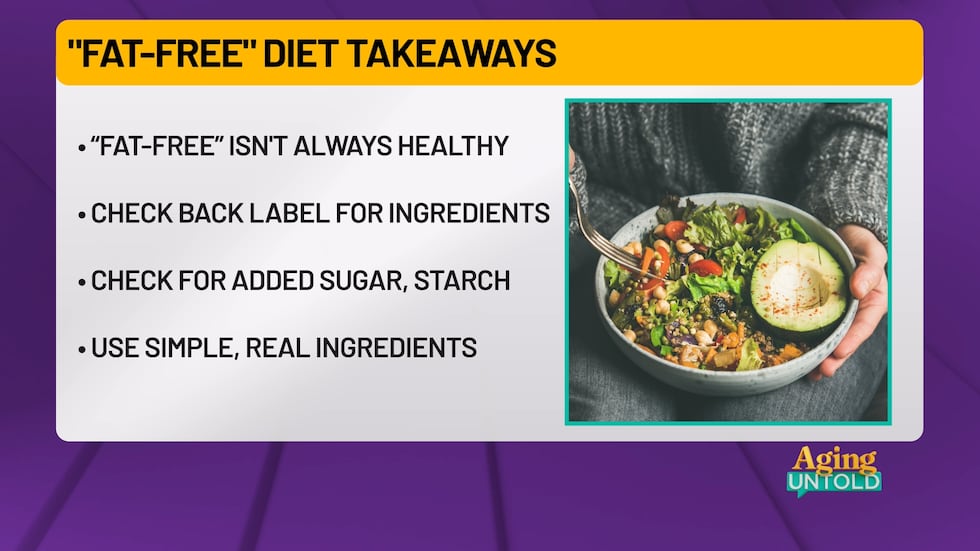
- “Fat-free” isn’t always healthy. When fat is removed from a product, manufacturers replace it with something else — often sugar, sweeteners or starches.
- Flip the package over. The front is advertising; the ingredient list on the back tells you what’s actually in the product.
- Use simple ingredients. Choose foods close to what your great-grandparents would recognize is a simple way to eat more naturally.
Copyright 2026 Gray Media Group, Inc. All Rights Reserved.